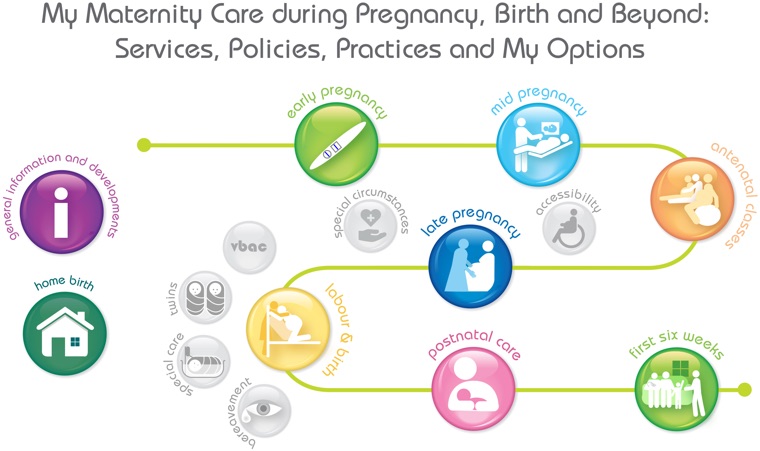
General Information and Developments
Home Birth
Where you decide to give birth affects your experience, both your birth outcomes and how you feel about the process, and your transition to motherhood. This can be one of the primary reasons that women and their families opt for home birth as a safe and viable option.
Offering home birth and supporting women with uncomplicated pregnancies in their choice to birth at home has not yet become common practice in Ireland, despite best evidence. However, the National Maternity Strategy 2016–2026 recommends that these services become standard practice within its time frame. To put the Irish home birth rates in context, the Planned Home Births in Ireland Annual Report 2015 states, “In Ireland today 0.2% of births occur at home. This rate is slightly lower than the home birth rate in the United States of America (0.7%), much lower than England (2.2%) and Wales (3.1%) and significantly lower than the Netherlands, where almost one quarter of births are reported to be in the home.”
Several large studies in recent years have overwhelmingly concluded that where a home birth is planned, supported and resourced, it is a safe option for women in normal pregnancies. We do know that there is a small increase in risk for first babies born at home; the reason for this has yet to be extrapolated from the latest research. We also know that all births carry some element of risk, albeit small, no matter where they take place.
The reasons women and their families may choose home birth are many, including
- getting to know their maternity care provider and having the benefits of one-to-one midwifery care
- giving birth in familiar and private surroundings
- having the support people they want present with no limit on numbers
- use of a pool and the option of water birth
- avoiding the use of pharmacological pain relief
Not only can a home birth be a safe and satisfying experience, it is also associated with benefits to the mother and baby, such as fewer interventions and caesarean births, and an increase in breastfeeding success. The cost of home birth care ranges from free HSE services to various private care packages, which are often covered by private health insurance plans.
Annual statistics are collated by the National Perinatal Epidemiology Centre (NPEC) and can be found on their website
Home births with hospital-based teams of midwives
Community midwifery services are designed for women who are classified as being at ‘low risk of complications’. If this option is available in your local area, you would see a team of midwives for your antenatal care, free of charge. Under the usual definition of a Community Midwives scheme, a mother has the option of giving birth either at home or in the hospital, attended by a midwife from the team. Antenatal visits take place either in the hospital or in an outreach centre such as a health centre. Some antenatal visits may take place in your home; this varies from scheme to scheme. All early postnatal visits take place in your home.
Note that some maternity units use the term ‘Community Midwives’ but do not offer an option for home birth.
Women report high levels of satisfaction with midwife-led care and these schemes are often in high demand. If you are interested in this care, it is best to enquire as early as possible and arrange a booking visit. This typically takes place at about 12 weeks of pregnancy and will include an assessment of your suitability for the scheme for the remainder of your pregnancy. If you would like to avail of these services but they are not currently available at your hospital, be sure to let your Director of Midwifery know. Demand will be taken into account when planning future services.
There are 3 hospital-based schemes in the Republic of Ireland offering home birth services:
- National Maternity Hospital, Dublin (Community Midwives)
- Waterford Regional Hospital (Integrated Hospital and Community Midwifery Service)
- Wexford General Hospital (home birth with the DOMINO midwives scheme)
Home Birth with Self-Employed Community Midwives under the HSE scheme
This HSE home birth pathway of care offers a tailored, supportive approach that meets the needs of the woman and her family. This pathway offers choice, control and continuity of care to women. This service, funded by the HSE, is available to all women who meet the eligibility criteria and who can secure a Self-Employed Community Midwife (SECM) to provide their care.
This HSE service is currently provided by 16 SECMs spread geographically over the Republic of Ireland. Midwives are based in the communities in which they live and provide individualised, holistic midwifery care for the growing numbers of women who choose the HSE home birth pathway.
Birth is a normal life event and SECMs promote the physiological nature of birth as underpinned by the National Maternity Strategy (DOH 2016). SECMs are committed to respecting the rights and wishes of the woman and her family in a compassionate and kind manner, while providing high-quality, individualised care focused on safety and best practice.
The focus is on collaborative care, which is ‘shared’ between the hospital, the GP and the SECM. SECM care is provided throughout the pregnancy, labour, birth and postnatal period, with funding for eleven visits inclusive of labour and birth and for up to two weeks postnatally.
Each midwife assesses a woman’s suitability under the criteria of a memorandum of understanding set by the HSE. A woman’s pregnancy needs to be ‘normal/low risk’ to avail of home birth services. Please follow this link for more information regarding the process and eligibility criteria.
During the antenatal period, the midwife individualises her care to meet the mother’s needs and that of her family. Visits normally last over an hour, as the midwife also gets to know the whole family. Midwives provide up-to-date evidence-based information on all aspects of midwifery care, based on robust HSE policies and guidelines. If there are any deviations from the norm during the pregnancy a woman will be referred to the consultant-led team at her local hospital.
Support is given during labour and birth in the form of monitoring the safety and well-being of mother and baby. It also includes promoting comfort measures to the mother and giving environmental, psychological and spiritual support to the whole family as labour unfolds.
There is an effective system in place for the SECM to notify the local maternity unit and arrange an ambulance to be on stand-by in case the mother needs to be transferred to hospital during labour. If a transfer is deemed necessary by the midwife, the same midwife travels with the mother into hospital and stays with her in an emotionally supportive but nonclinical role.
Postnatal support from the SECM involves giving physical and psychological support including discussing/debriefing the birth experience, infant feeding (with support provided until breastfeeding is established), baby-care skills and facilitating the transition to motherhood. In addition, they complete screening tests and arrange follow-up appointments as required.
The HSE pays each SECM for providing a home birth service. Some midwives may charge an additional fee for some aspects of their care. Some SECMs lend hydrotherapy birthing pools and/or TENS machines or teach Hypnobirthing techniques to couples to complement and support the home birth experience.
SECMs work individually, but it is a requirement to plan to have a second midwife in attendance at all births. It is also necessary to ensure that the GP has insurance that supports women who wish to avail of the home birth service. SECMs are insured through the HSE Clinical Indemnity Scheme.
All SECMs partake in a professional peer review process, which recognises the philosophy, practice and community-based environment within which they work. All SECMs are members of the Community Midwives Association
Home Birth with Private Midwives
Midwives at Private Midwives actively offer choice, control and continuity through compassionate midwifery care which is tailored to the needs of the individual. They facilitate home birth and nonclinical support in hospital, with the ‘peace of mind’ guarantee that there will always be back-up support.
As a team passionate about the promotion of normality in childbirth, they work in partnership with other practitioners who offer a range of complementary therapies and services aiming to achieve optimum outcomes for all.
Their practice philosophy is based on a commitment to pregnancy and birth as normal life events; they are committed to recognising and respecting the rights and wishes of the individual woman and her family. Continuity of care and a woman's right of choice is at the very heart of their professional ethos.
Private Midwives provide safe, individualised maternity care. Their team of experienced, dedicated midwives are on hand to help women achieve the birth they and their babies deserve, with continuity of care from midwives they know and trust.
How does care with Private Midwives work?
Private Midwives advise all clients to book at a maternity hospital of their choice and avail of free blood tests, a dating scan and an anatomy scan. Until the point at which care with them commences, they advise that women attend all antenatal appointments with the hospital and/or their GP.
They can provide a full range of maternal blood tests privately at additional cost and can advise on where to attend should women wish to avail of a private scan at their own expense.
Once a woman’s care package commences they will provide all her appointments and only ask her to attend her GP or hospital if concerns arise. This will be discussed with her fully at the time and balanced information on the situation will be provided.
Should a mother choose to continue her hospital and/or GP appointments whilst seeing her midwife, they are happy to support you in that decision.
Antenatal Care
They provide antenatal care packages ranging from a single appointment to full care from 6 weeks of pregnancy and fees vary accordingly. Antenatal care can be booked alongside a birth package, or as a stand-alone option.
Appointments usually take place in a client’s home and last for a minimum of an hour and a half. Family members are welcome and the same midwife attends every appointment unless otherwise agreed.
Appointments include clinical care (BP, urinalysis, abdominal palpation and auscultation of the fetal heart) alongside information and education on pregnancy, birth and postnatal days.
Labour and Birth
They provide options for home birth or nonclinical support in hospital. When planning a home birth, they are under obligation to provide antenatal care from a minimum of 36 weeks of pregnancy and at least one week of postnatal care.
At home, the family are supported by their continuity carer midwife and a second midwife who, ideally, they will have previously met. Labour support includes monitoring of the well-being of the mother and baby and progress of labour. Midwives also provide physiological, psychological and spiritual support in labour, a holistic and individualized approach with partnership in care at its heart.
Family members, friends and doulas are welcome at the mother’s discretion.
Transferring to hospital
Private Midwives link in with the National Ambulance Service (NAS) before the client is 36 weeks pregnant. This includes an Eircode and handwritten instructions on the location of birth as well as the booked hospital. On attending a home birth the midwife will notify the NAS of a home birth in progress and confirm a reference number. In the event that a transfer becomes necessary, the midwife calls the NAS and gives the reference number and an ambulance is assigned to attend.
Upon transfer, the midwife remains with the woman in the ambulance and upon arrival to hospital hands over care. With the hospital’s permission, the midwife will then remain in attendance in a nonclinical role and provide ongoing support to the family.
Postnatal Care
Private Midwives offer a variety of postnatal care options, from one appointment through to a full 6 weeks of care. They also offer overnight support and intensive breastfeeding support programmes. Postnatal care can be booked as a stand-alone option or as part of a birth package.
Postnatal appointments are in the family’s home and last between one and one and a half hours, and are attended by the same midwife at every appointment, unless otherwise agreed. The midwife undertakes clinical checks of baby and mother as required including the newborn heel prick test. Parentcraft education is provided and support with feeding (breast or formula) is a core part of the appointments. Discussion of the birth and mental health support is also key at this special time.
For more information visit the Private Midwives website
General Information - Private Midwives.pdf Antenatal Care - Private Midwives.pdf Antenatal Education - Private Midwives.pdf Care During Labour and Birth - Private_Midwives.pdf Special Care - Private Midwives.pdf Postnatal Care - Private Midwives.pdf Postnatal Period - Frist Six Weeks - Private Midwives.pdf Accessibility Bereavement and Special Circumstances - Private Midwives.pdf Developments and Services - Private Midwives.pdf