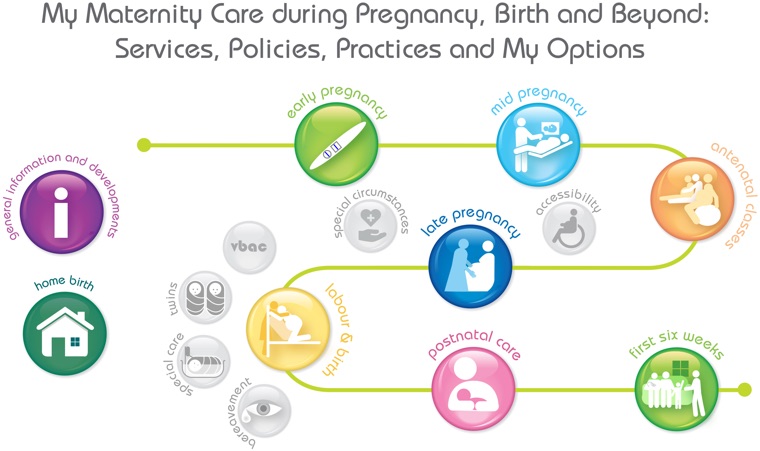
General Information and Developments
Late Pregnancy
I'm in late pregnancy. Is there an emergency phone number or 24-hour drop-in support service available to me?
Yes, in all but one unit. Mothers are advised to phone in at any time with any concerns. In some instances there is a specific assessment unit Mon-Fri during daytime hours. Outside these hours, or where there is no assessment unit, women can go to the labour ward or admissions area.
| Services available: | |
|---|---|
How will I be helped to prepare during pregnancy for pain management during labour?
The majority of units encourage mothers to attend antenatal classes. Several units discuss birth plan options with women. Leaflets are widely available and women can explore pain relief options with their caregivers. In some units, mothers can meet anaesthetists antenatally if necessary.
| How are women helped to understand their pain management options?: | Show All |
|---|---|
I'm in late pregnancy and my baby is breech. What usually happens?
Two units did not answer this question.
The majority of babies are in a head-down position in late pregnancy. Approximately 3% of babies are breech – their head is up and their pelvis is down near their mother's cervix.
Thirteen units offer ECV (external cephalic version) to women who are suitable for the procedure. This involves relaxing the uterus and manually manipulating the baby into a head-down position. The baby is monitored during this process. Only two units offer information on complementary therapies to help turn breech babies.
If methods for turning the baby fail in units where ECV is offered, a planned caesarean birth is usually then recommended. In other units, no ECV is offered and the policy is a planned caesarean birth.
| Routine management of breech babies: | Show All |
|---|---|
See also our question in Care During Labour and Birth "If my baby was still breech at full term, how would this affect my labour and birth?" for more information and detailed breech birth data.
Is vaginal breech birth an option in my unit?
Not all units answered this set of questions. No unit routinely offers vaginal birth for breech babies in preference to caesarean birth. However, almost half the units reported vaginal breech births for 2014 and 2015 (some of which may have been the second twin or premature babies). Some units stated that breech babies are sometimes born vaginally if labour is very far along when the mother arrives to hospital.
The 2017 national clinical guideline for the management of breech presentation states that for women who have given birth vaginally before, and where the baby is full-term and normal that "it is reasonable to deliver the baby vaginally" as long as there are no complications. Only 6 units indicated that mothers have the opportunity to make informed decisions in partnership with their caregivers about which way to birth their breech baby.
| Circumstances where vaginal breech births occur: | Show All |
|---|---|
| Vaginal breech births 2014: | Show All |
| Vaginal breech births 2015: | Show All |
| Support for women who opt for a vaginal breech birth | Show All |
Under what circumstances might a mother need to be admitted to hospital in pregnancy?
Women generally receive all their antenatal care as outpatients but can be admitted for a wide variety of reasons. These include medical or high-risk conditions, from hyperemesis to threatened preterm labour, bleeding and infection requiring inpatient treatment, to unstable lie (position of baby unstable) at term, or concerns over growth.
Under what circumstances might a pregnant woman need to be transferred to a tertiary hospital?
In cases where a maternity unit cannot provide the required care for a woman or her unborn baby, she can be transferred to a tertiary unit for specialist or complex care.
Under what circumstances would a planned caesarean birth be recommended?
Units reported that typical reasons included breech and other malpresentations; twins if the first twin is not head down; pre-eclampsia; placenta praevia; two previous LSCS (lower segment Caesarean section); and other concerns for fetal or maternal well-being. Two units listed one prior caesarean birth as an indication for a planned caesarean. Two units specified all multiple pregnancies.
As vaginal birth is generally safer than a caesarean birth, a maternal request for a planned caesarean will be dealt with on an individual basis, normally involving detailed discussion with caregivers.
| Indications for planned caesarean birth: | Show All |
|---|---|
| Maternal request for caesarean birth: | Show All |
For what medical reasons might an induction be recommended?
Clinical reasons listed by the units included babies that were either small for dates or large for dates; high blood pressure; twins and other multiples; diabetes/gestational diabetes; and any other reasons where there may be concerns for a mother's and/or a baby's well-being.
Units also offer induction to women if they are 'overdue' or 'post dates' (see question below).
Women generally have the option of additional monitoring if they choose to decline or defer induction. In these cases, women make decisions in partnership with their caregivers.
| What are the options for women who decline induction for medical reasons?: | Show All |
|---|---|
I'm in late pregnancy. What is my local maternity unit's policy on cervical sweeps?
A cervical sweep - If you've gone past your due date, your midwife or doctor may offer to "sweep" your membranes. This involves inserting a finger gently into your cervix and running it between the top of the cervix and the bag of waters. This has been shown to increase the likelihood of labour starting in the next few days (50/50 chance), and to decrease the need for induction, but it isn't always effective, often causes cramping and spotting, and carries the risk of accidentally releasing the waters and infection.
Not all units answered this question. Of those that did, one unit stated that cervical sweeps are not performed and one other does not have a policy. All other units' answers varied from "maternal request", to "decided on an individual basis" to "obstetrician's decision". Some specified that sweeps were offered at term (40 weeks), at 41 weeks or at term +10 days. One unit mentioned repeat sweeps at 72- hour intervals if necessary.
| Cervical sweeps: | Show All |
|---|---|
What happens if I go past my due date?
All units answered this question.
Units offer induction for being overdue varying from at term (40 weeks) +10 days (nine units); between term +10 and term +14 days (two units); at term +12 days (one unit); and at term +14 days (one unit). Four units stated it was based on individual assessment, and in one unit it "varies from consultant to consultant".
Women generally have the option of additional monitoring if they choose to decline or defer induction. In these cases, women make decisions in partnership with their caregivers.
| Induction for post-dates: | Show All |
|---|---|
| What are the options for women who decline induction for post-dates?: | Show All |