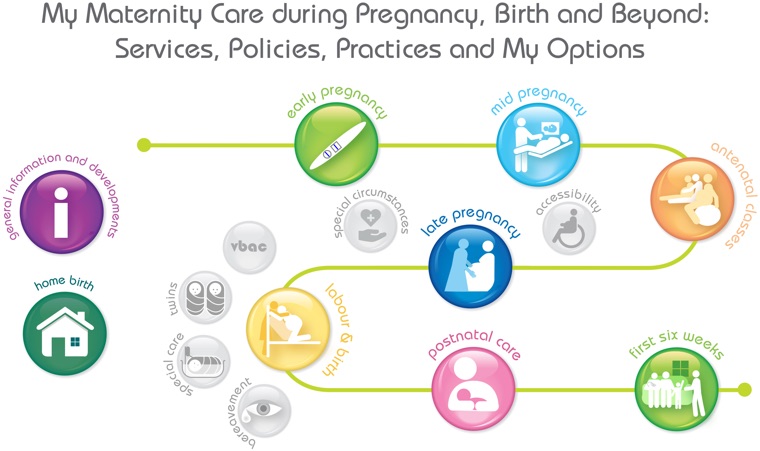
General Information and Developments
Early Pregnancy
I'm pregnant. How do I book into a maternity unit?
Over 50% of units stated that you can book in by contacting them directly when you're pregnant. However, all units will accept a G.P. referral letter. Other less frequent methods of referral are via the following services: gynaecology clinics, infertility clinics, early pregnancy units and referral from other hospitals.
| Self-referral: | |
|---|---|
| G.P. Referral: | |
| Other comments |
I'm in early pregnancy and I suspect something is not right. What should I do?
Most units have an early pregnancy unit/clinic, but not all are open 24 hours a day: some operate Monday-Friday during daytime hours. If you contact your unit, they will advise you on your next step, which might be an appointment with the early pregnancy unit/clinic.
Some units provided information on how they support mothers with hyperemesis gravidarum (an extreme form of 'morning sickness' – severe vomiting leading to dehydration and weight loss).
| Services provided in very early pregnancy: | Show All |
|---|
What are my choices/options in maternity services? Who can I choose to care for me?
The number of options available to you – about where you have your antenatal care, where you choose to birth your baby and who foots the bill! – very much depends on where you live in Ireland. Various options around the country include Midwifery-Led Units, Community Midwives (including a homebirth service), DOMINO services, combined antenatal care (G.P. & hospital), public care, semi-private care, private care. There are also other home birth options with care provided by self-employed community midwives (SECM) under the HSE home birth service or provided by a private company – click here for more information on these options.
Midwifery-Led Care
Midwifery-Led Units
A Midwifery-Led Unit offers you the chance to birth your baby in a homely environment with a midwife you have come to know during your antenatal care. These units provide healthy women, with no/low risk factors for pregnancy and labour, a safe and satisfying choice in how they access free maternity care. A team of experienced midwives provides the care. Mothers give birth in a uniquely designed birthing room where they will be cared for by a midwife they have already met and where they can avail of facilities such as music, a water pool and supportive aids (gym ball, bean bags etc.). Pain relief (Entonox, also known as 'Gas & Air', and Pethidine) is available if requested. Mothers have the option to have an early discharge home, i.e. discharged home within 6-48 hours of having their baby, and one of the team of midwives will visit them on a daily basis at home up to the 7th postnatal day, after which the care of the mother and baby will be transferred to the public health nurse. Mothers also have the option of staying in the unit in a private room that can also accommodate other family members.
If, at any point during pregnancy or labour, a problem is detected or anticipated, care will be transferred to the obstetric-led services in the main hospital.
There are currently only 2 Midwifery-Led Units (MLUs) in the Republic of Ireland:
- MLU at Cavan General Hospital
- MLU at Our Lady of Lourdes Hospital, Drogheda
Community Midwives & Domino Care
Community Midwives and Domino Care services are designed for women who are classified as being at 'low risk of complications'. If either of these options is available in your local area, you would see a team of midwives for your antenatal care free of charge. Under the usual definition of a Community Midwives scheme, a mother has the option of giving birth either at home or in the hospital, attended by a midwife from the team. With a DOMINO service, mothers give birth in hospital, but not necessarily attended by a midwife from the team. (DOMINO stands for DOMiciliary IN and Out. Domiciliary means taking place in the home.) Antenatal visits take place either in the hospital or in an outreach centre such as a health centre. Some antenatal visits may take place in your home – this varies from scheme to scheme. All early postnatal visits take place in your home.
Some units use the term 'Community Midwives' but do not offer an option for home birth. Some Community Midwives/DOMINO teams include care during labour, but others provide only antenatal and/or postnatal care. We tried to standardise the information from all the units, but it was difficult due to the various combinations of services offered.
Women report high levels of satisfaction with midwifery-led care and these schemes are often in high demand. If you are interested in this care, it's best to enquire as early as possible and arrange a booking visit. This typically takes place at about 12 weeks of pregnancy, and will include an assessment of your suitability for the scheme for the remainder of your pregnancy. As part of these services, you are entitled to an early hospital discharge and home visits from a midwife for up to a week after your baby is born. If you would like to avail of these services but they are not currently available at your hospital, be sure to let your Director of Midwifery know. Demand will be taken into account when planning future services.
There are 6 of these schemes in the Republic of Ireland, all offering different combinations of services:
- Cork University Maternity Hospital, Cork (DOMINO service offered by their Community Midwives: no home births but births in hospital attended by midwives from the team)
- National Maternity Hospital, Dublin (Community Midwives, including home birth and DOMINO options for birth: all attended by midwives from the team)
- Rotunda Hospital, Dublin (DOMINO service offered by their Community Midwives: births in hospital not usually attended by midwives from the team)
- Coombe Women and Infants University Hospital, Dublin (DOMINO service offered by their Community Midwives: births in hospital usually attended by midwives from the team)
- Waterford Regional Hospital (Integrated Hospital and Community Midwifery Service includes home birth and DOMINO options for birth: all attended by midwives from the team)
- Wexford General Hospital (home and DOMINO options for birth with the DOMINO midwives scheme: home births offered and attended by midwives from the team; births in hospital often attended by midwives from the team on rotation in the labour ward)
Obstetric-led care
Public Care
Every woman is entitled to free maternity care. This is irrespective of whether or not you have a medical card, private health insurance (e.g. VHI, Aviva, Laya Healthcare) or are a member of a healthcare cash plan (e.g. Hospital Saturday Fund).
Public care includes all antenatal care, all care during labour and childbirth, and all postnatal care. It covers all hospital accommodation costs for you and your baby, and postnatal visits in your home if they are offered by your maternity unit. You are not guaranteed to see the same doctor/midwife at each visit to the public antenatal clinic or during postnatal care.
Several hospitals offer public patients the option of attending the Midwives' Clinic. These clinics are staffed by experienced midwives. The clinics are for women with uncomplicated pregnancies, offering continuity of carer where possible for antenatal care. Each hospital sets its own criteria for which women can attend the Midwives' Clinic, so check with the hospital if you are interested in this option.
During labour and birth the hospital midwives will provide your care. In a straightforward birth, you do not need the care of a doctor at all. If there are any complications or you need an instrumental birth or caesarean birth, the doctor on duty will attend you. You may not have met any of these midwives or doctors before.
After your baby's birth you will stay in a public ward and the number of beds in each public postnatal ward varies from unit to unit.
Semi-private Care
Semi-private care appears to mean different things in different hospitals. Sometimes it means that you see a consultant privately when you are pregnant, but the birth of your baby will be attended by whichever doctor is on duty. Another system is where you attend a semi-private clinic run by a consultant and senior members of his/her team. In a straightforward birth, someone from the team is generally available to check in on you during your labour and is present for a short while just as the baby is being born. If there are any complications or you need an instrumental birth or caesarean birth, a doctor from the team will attend you.
After the birth you usually stay in a semi-private ward if there is availability, which may mean sharing with up to five other mothers.
Some hospitals do not provide the option of semi-private care at all. Semi-private care is significantly cheaper than private care.
Private Care
If you choose private antenatal care, you will see a consultant obstetrician of your choice at each antenatal visit, either in the hospital or in the consultant's private rooms. The private option means that you see the same person at each visit.
During a straightforward labour, consultant obstetricians check in on women who have opted for private care. They are also likely to be present at the end of labour as the baby is being born. If there are any complications or you need an instrumental birth or caesarean birth, he/she will attend you. He/she will usually make alternative arrangements for cover with a consultant colleague if he/she anticipates being away around your due date.
After the birth you should have a degree of privacy as you will usually stay in a private room. However, you may have to spend some/all of your stay in a public or semi-private ward if a single room is not immediately available.
In 2016, the ESRI reported a significant difference in the rate of caesarean births in private care versus public care. A higher percentage of mothers in private care gave birth by elective (planned) caesarean section than could be accounted for by factors like the health of mothers and differences between hospitals.
Midwifery-led services available (remember, the definitions vary from unit to unit):
| Midwifery-led unit (stand-alone): | |
|---|---|
| Community midwives' clinic: | |
| DOMINO midwives' clinic: | |
| Public midwives' clinic: | |
| Further information: |
Obstetric-led services available:
| Public clinic: | |
|---|---|
| Semi-private clinic: | |
| Private clinic: | |
| Further information: |
What is combined care and is it available to me?
This is where your GP provides about half of your antenatal care. Virtually all GPs participate in the Maternity and Infant Care Scheme, but double-check with your GP first. Those GPs that participate are reimbursed by the HSE, so you do not need to pay for any of your visits to your GP for antenatal care – not even the first one to confirm your pregnancy.
Combined care is an option for women who are availing of public, semi-private and private care or midwifery-led services. Some private obstetricians are happy for their clients to make antenatal visits to their GP and may reduce the fee accordingly.
Hospital-only care is available in some clinics or for some women with high-risk factors, but combined care tends to be encouraged.
Combined care with G.P.
| Available for women using midwifery-led services: | |
|---|---|
| Additional comment: | |
| Available for women using obstetric-led services: | |
| Additional comment: |
Hospital-only care
| Yes, for women using midwifery-led services: | |
|---|---|
| Yes, for women using obstetric-led services: | |
| No: | |
| Additional comment: |
Where will my antenatal clinic be located?
All units have antenatal clinics at the hospital. Some units provide outlying antenatal clinics in their catchment area in health centres or other community locations. In a few instances, private care is provided off-site in consultants' rooms.
Midwifery-led services:
| Midwifery-led unit: | |
|---|---|
| Community midwives' clinic: | |
| DOMINO midwives' clinic: | |
| Public midwives' clinic: | |
| Further information: |
Obstetric-led services:
| Public clinic: | |
|---|---|
| Semi-private clinic: | |
| Private clinic: | |
| Further information: |
When can I expect to have my first antenatal appointment?
This ranges from 12-22 weeks depending on the unit and the particular service you choose. The vast majority of units offer appointments as early as 12 weeks or between weeks 12-14/15 weeks; one unit stated 10-14 weeks, two stated 14-16 weeks, and one unit's booking visits are much later at 18-22 weeks.
Typical timing for booking visit (first antenatal visit) :
Midwifery-led services:
| Midwifery-led unit: | |
|---|---|
| Community midwives' clinic: | |
| DOMINO midwives' clinic: | |
| Public midwives' clinic: | |
| Further information: |
Obstetric-led services:
| Public clinic: | |
|---|---|
| Semi-private clinic: | |
| Private clinic: | |
| Further information: |
What routine tests can I expect to have at my first antenatal appointment?
In addition to noting your medical history, there is a range of tests that are typically done at a booking visit.
Routinely tested at booking visit
| Blood pressure: | |
|---|---|
| Urine: | |
| Weight: | |
| Height: | |
| Palpation/fundal height: | |
| Fetal heart rate: | |
| Ultrasound: | |
| Full blood count: | |
| Blood group & antibodies: | |
| Rubella immunity: | |
| Chicken pox immunity: | |
| HIV: | |
| Hepatitis B: | |
| Syphilis: | |
| Blood glucose: | |
| Hepatitis C: | |
| Ferritin: | |
| Other: |
Do I carry my own hospital records?
Just under half of the units routinely offer this option. This may change as there is a new electronic data recording system being rolled out to all maternity units in Ireland in 2018 onwards.
| Yes/No: | |
|---|---|
| Comments: |
Will I see the same person at each antenatal visit?
Feedback from women shows that continuity of carer (seeing the same person or small team of people at each visit) can make a big difference to their level of satisfaction with their care. Usually midwifery-led services are set up so that women see the same midwife or one of a small team at each of their antenatal visits. Public clinics with doctors often mean that women see a different person each time they attend the clinic. In semi-private clinics, which are available in some hospitals, women usually see one of team of doctors. In private care, women typically see the same consultant obstetrician at each visit.
Continuity of carer
Midwifery-led services:
| Continuity of carer | Not applicable | See the same person every antenatal visit | See one of team (8 people or less) every antenatal visit | May see a different staff member every antenatal visit |
|---|---|---|---|---|
| Midwifery-led unit: | ||||
| Community midwives' clinic: | ||||
| DOMINO midwives' clinic: | ||||
| Public midwives' clinic: | ||||
| Other midwifery-led clinics: |
Obstetric-led services:
| Continuity of carer | Not applicable | See the same person every antenatal visit | See one of team (8 people or less) every antenatal visit | May see a different staff member every antenatal visit |
|---|---|---|---|---|
| Public clinic: | ||||
| Semi-private clinic: | ||||
| Private clinic: | ||||
| Other obstetric-led clinics: |
How much time can I expect will be given to me at each antenatal visit/appointment?
If you choose a midwifery-led service, where it's available, you will be given approximately 30 minutes per visit. If you choose an obstetric-led service you will be given from 5-20 minutes per visit - this varies from clinic to clinic. Usually a booking visit lasts at least 30 minutes for all clinics.
Approximate length of consultation with carer
Midwifery-led services:
| Booking visit | Follow-up antenatal visit | |
|---|---|---|
| Midwifery-led unit: | ||
| Community midwives' clinic: | ||
| DOMINO midwives' clinic: | ||
| Public midwives' clinic: | ||
| Other midwifery-led clinics: |
Obstetric-led services:
| Booking visit | Follow-up antenatal visit | |
|---|---|---|
| Public clinic: | ||
| Semi-private clinic: | ||
| Private clinic: | ||
| Other obstetric-led clinics: |
What is the average waiting time and what facilities can I expect at my chosen clinic?
Waiting times and facilities vary a lot. Busy public clinics often have long waiting times and there are not always enough seats for everyone. Not all have play areas for children or nappy changing facilities. Not all units have easy access to food and drink for women and their families.
Average waiting times and facilities at each clinic:
| Service | Waiting less than 30 minutes | Waiting more than 30 minutes | Play area for children | Nappy changing facilities |
|---|---|---|---|---|
| Midwifery-led unit | ||||
| Community midwives' clinic | ||||
| Domino clinic | ||||
| Public midwives' clinic | ||||
| Public clinic | ||||
| Semi-private clinic | ||||
| Private clinic |
| Service | Sufficient seating for all women while waiting | Sufficient seating for all partners while waiting | Refreshments/drinking water | Food vending machine | Cafeteria |
|---|---|---|---|---|---|
| Midwifery-led unit | |||||
| Community midwives' clinic | |||||
| Domino clinic | |||||
| Public midwives' clinic | |||||
| Public clinic | |||||
| Semi-private clinic | |||||
| Private clinic |
Other information provided:
| Midwifery-led unit: | |
|---|---|
| Community midwives' clinic: | |
| Domino clinic: | |
| Public midwives' clinic: | |
| Public clinic: | |
| Semi-private clinic: | |
| Private clinic: |
I'm in early pregnancy. Will I be asked to state how I intend to feed my baby?
Over half of the units responded that they 'always' ask mothers how they intend to feed their babies, but almost a quarter say they 'never' do.
Are mothers asked to state how they intend to feed their babies?
| Always: | |
|---|---|
| Mostly: | |
| Sometimes: | |
| Never: | |
| Further information: |
What leaflets are available?
Units typically have a range of leaflets available. Some units provide an information booklet or magazine instead.
Leaflets available
| Antenatal blood tests: | |
|---|---|
| Healthy eating: | |
| Smoking cessation: | |
| Iron supplements: | |
| Folic acid: | |
| HIV testing: | |
| Toxoplasmosis: | |
| Rhesus factor: | |
| Pelvic floor exercises: | |
| Vaginal birth after caesarean (VBAC): | |
| Labour bag & hospital bag: | |
| Signs of labour: | |
| Labour and birth: | |
| Pain relief options: pharmacological: | |
| Pain relief options: non-pharmacological: | |
| Caesarean birth: | |
| Breastfeeding: | |
| Infant feeding: | |
| Postnatal depression: | |
| Postnatal care: | |
| Car safety for babies: | |
| Sudden Infant Death Syndrome: | |
| Normal newborn characteristics: | |
| Neonatal screening: | |
| Antenatal classes provided by hospital/unit: | |
| Independent antenatal classes in the community (e.g. Antenatal Ireland (Cuidiú) classes): | |
| Care plan (details of visits to GP and to chosen clinic): | |
| Contact details for support services: | |
| Other: |
I smoke. Is there help available to stop?
The majority of maternity units offer a smoking cessation service, but four units do not.
| Is there a Smoking Cessation programme (17 out of 21 units)?: | |
|---|---|
| Additional comments: |
How does my maternity unit support women who have had miscarriages?
All but one maternity unit provide supports ranging from early pregnancy units, to pastoral support, to bereavement counselling. Several mentioned assistance with burial arrangements. Some mentioned providing a single room where possible.
| Special support provided to parents in the case of a miscarriage: | Show All |
|---|---|
If I want one, when can I expect my first scan?
Very early scans (<12 weeks) are usually only available to women who are using the services of an early pregnancy unit for threatened miscarriage, previous history of miscarriage, suspected ectopic pregnancy or being identified as high-risk early in pregnancy.
Eighty percent of units offer a dating/first trimester scan around 12 weeks of pregnancy to all women using their services. Two units stated this would be offered if required. One unit didn't answer and another stated that 80% of women attending that hospital have a first trimester scan.
A detailed scan examining the baby's anatomy (sometimes called an anomaly scan) can be used to investigate known or suspected problems, but it is also a screening tool. It can pick up certain issues that would not otherwise be detected during routine antenatal care. An anatomy scan is routinely offered in the 2nd trimester (typically between 18-24 weeks) in only nine units in Ireland. Five units do not offer these scans at all but can refer mothers to another hospital if required. In five more units, it is available if required. Two units did not answer the question.
Some, but very few, units offer scans to mothers at routine antenatal visits. Most stated that it depended either on the caregiver or was based on the individual clinical need with higher risk pregnancies generally requiring more scans. A mother's request for scans can sometimes be accommodated but may be declined if there is no clinical need.
Information on scans available:
| Early pregnancy scans (< 12 weeks): | |
|---|---|
| Dating scans: | |
| Anatomy/anomaly scans: | |
| Scans at routine antenatal visits: | |
| Comments on any differences in number/frequency of scans depending on the type or care/carer chosen: | |
| Policy on scans at maternal request: |
What if an ultrasound scan gives a different EDD (estimated due date) from my own dates?
The policies on this vary from unit to unit, with some units estimating the due date based on the mother's LMP (last menstrual period) date. In others the EDD is only changed if there's more than a 7 or 10 day discrepancy between the mother's dates and the dating scan dates. Others use the dating scan. Others state that a consultant determines the date to use.
| Due date estimation using LMP dates or ultrasound scan: | Show All |
|---|